
When seeking out health insurance coverage past when it’s partially covered by your previous employer, how do you choose between picking COBRA or private health insurance?
Both have pros and cons. The right choice, however, depends on your unique circumstances.
Let’s discuss the pros and cons of COBRA vs. private health insurance.
What is COBRA?
The Consolidated Omnibus Budget Reconciliation Act (COBRA) is not insurance itself. Alternatively, COBRA is a law that was passed in 1985.
This law, COBRA, allows employees to continue on their existing health insurance plan if:
- They are reduced to work less than 30 hours a week, or
- Leave their job voluntarily or involuntarily
Under COBRA, the employee continues on his or her insurance plan but is then responsible to cover the entire cost. It is no longer the employer’s responsibility to cover health insurance premiums as they had previously.
COBRA, however, is not available to everyone. COBRA is only available to employees who worked at a public or private company with 20 or more employees.
What is Private Health Insurance?
Private health insurance, on the other hand, is any health insurance policy plan that is not run by a government-run insurance plan (i.e. Medicare, Medicaid, Obamacare).
This type of coverage, though not government-run, must comply with state and federal insurance regulations.
Depending on the type of insurance policy, regulations include:
- Affordable Care Act (ACA) essential health benefits
- Maternity care
- Meeting minimum essential coverage (MEC) requirements
- Providing minimum value to avoid employer mandate penalty
- Capping in-network and out-of-pocket costs
Pros and Cons of COBRA
Pros of COBRA
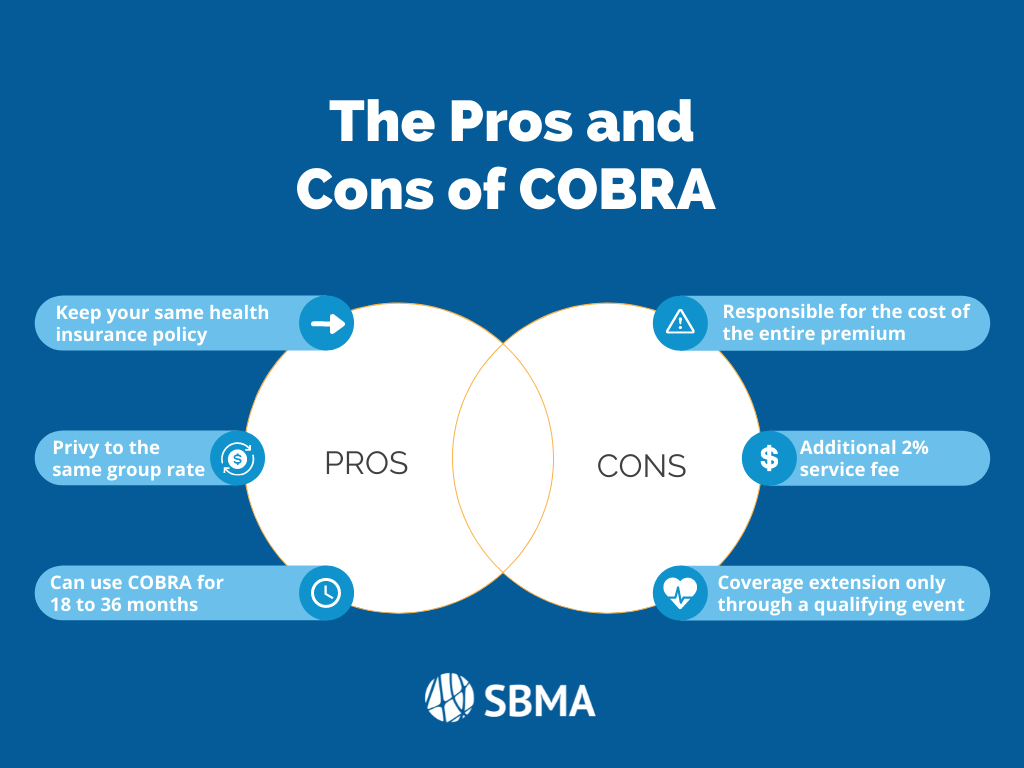
- COBRA allows you to keep your same health insurance policy in the event you lost your job voluntarily, involuntarily, or through a reduction of work hours.
- COBRA is an added security in case an unexpected life event occurs while you are unemployed.
- Beneficiaries continue the same coverage for preexisting conditions and prescription drugs.
- With COBRA offering an extension of your health coverage, you don’t have to pay for medical expenses out of pocket (i.e. doctor’s visits). Instead, you are still privy to the same group rate as the one you had with your previous job.
Lastly, you can use COBRA coverage for 18 to 36 months depending on why you need it. Plus, it can be extended depending on qualifying events.
Cons of COBRA
- COBRA coverage is not cheap. Why? Because you’re now responsible for paying your portion of your health insurance: The cost your employer contributed to your premium, in addition to the 2% service fee on the cost of your insurance.
A COBRA premium can cost on average $400 to $700 a month per person.
Calculate the Cost of COBRA
In order to calculate the cost of COBRA continuation coverage, add how much the employer contributes to the health plan, plus how much the employee contributes to the health plan, then multiply the sum by 2% for the service fee.
Please see the formula below:
(Employer contribution to coverage + Your Contribution) x 0.02% = COBRA Premium)
For example, an employer who contributes $400 a month for an employee who contributes $200 a month would bring the total to $600 towards contributions. Multiplied by the 2% charge, the COBRA cost each month would cost $612 each month.
Pros and Cons of Private Health Insurance
Pros of Private Health Insurance
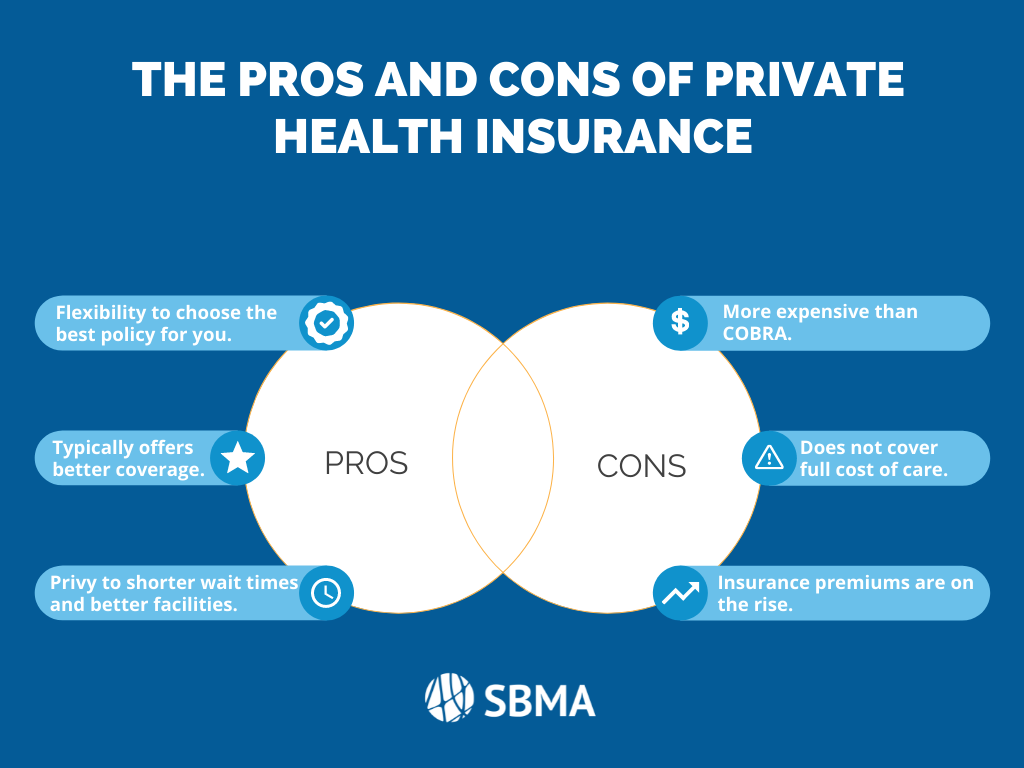
- If you use private health insurance, you have the flexibility to choose a policy that works best for you.
- In addition to building your own policy, sometimes you can also choose your own physician.
- Those who choose to use this type of health insurance coverage are also privy to greater coverage options and flexibility, shorter wait times, and better facilities
Cons of Private Health Insurance
- Private health insurance is even more expensive than COBRA. Some policies may only cover up to 80% of the cost of care.
- Private health insurance may offer limited coverage options depending on disease and condition.
Insurance premium costs are on the rise and show no sign of slowing down. As time goes on, the price of private health insurance is expected to continue increasing. Research found the national monthly average of insurance costs in 2022 sat at $541.
The Bottom Line
Both COBRA and private health insurance will help provide the security of having health insurance if you no longer have access to employee benefits. Weigh the pros and cons of each to see which policy fits your needs best.
Still have questions? Reach out to our expert team of brokers and visit our COBRA page to learn more.

